


In Defense of Commodore Pt.2: Licensing and Royalties
Last time I made the case for CDTV’s living-room appliance approach and why swapping keyboards and mice for a remote control and a compact disc made a lot of sense back in 1991. This time, I want to look at something that is often overlooked when people talk about CDTV: the licensing and royalty model that Commodore built into the platform. (If you just felt a small part of yourself die, that’s normal. It gets interesting, I promise).
Commodore’s earlier (computer) platforms, like the C64 and the Amiga, were completely open. Anyone could write software for them. You could register as a developer and receive documentation and support, but it was entirely voluntary. No license required, no fees owed, no permission asked. If you wanted to ship a C64 game, you just shipped it.
CDTV changed that. To publish a CDTV title, developers were required to sign up for one of the official CDTV developer plans and pay an annual license fee. In return, the license granted you a few things: the right to use CDTV trademarks on your packaging, and crucially, the right to include a special file called CDTV.tm on your disc.
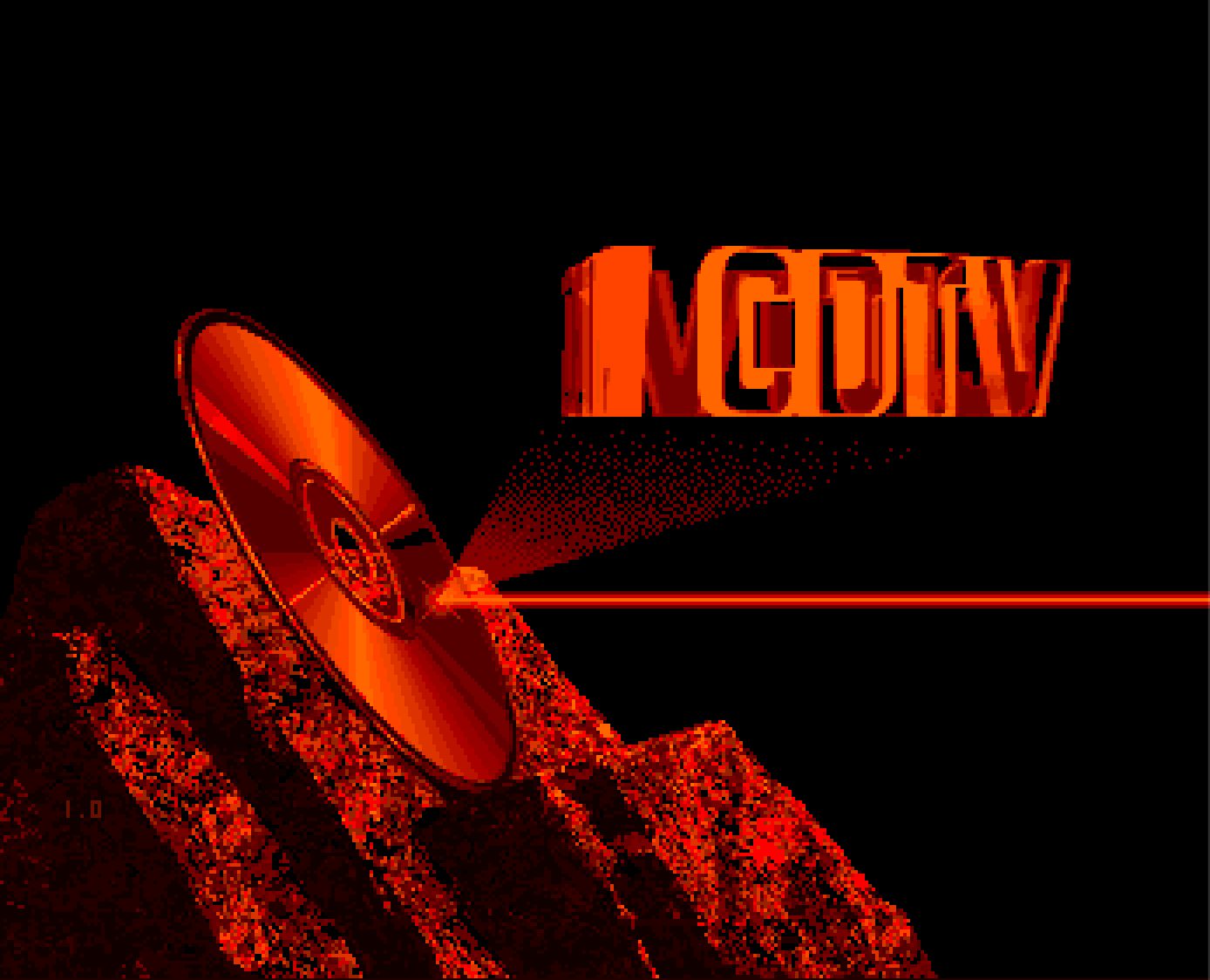
The CDTV boot logo that’s inside the CDTV.tm license file
That file was the key to the whole thing. Without it, the CDTV player simply refused to boot the title and threw up the infamous red error screen. The file contained trademarked and copyrighted data: specifically the CDTV boot logo image and an early version of the cdtv.device driver. The boot logo was display on erm.. boot, which indicated the CD passed the license check. The cdtv.device driver code is never actually used, it’s just dead weight from a technical standpoint. But that’s rather the point: it’s there as a copyrighted artifact. Include it without a license and Commodore could, in theory, come after you for copyright and trademark infringement. It was a reasonably elegant way to enforce the licensing system through legal leverage rather than purely technical means. Commodore’s approach here mirrors the Game Boy cartridge logo method introduced by Nintendo in 1989.
Nintendo Money
But the real money (or the money Commodore hoped to make) wasn’t the annual license fee. It was the royalties. For every CDTV title manufactured, the developer or publisher owed Commodore 25 cents per unit. It doesn’t sound like much, but if you sell enough of them, 25 cents has a way of adding up into something that looks almost like a business plan. Commodore was very clearly looking at what Nintendo had built in the second half of the 1980s and liking what they saw. Nintendo’s iron grip on the video game market in North America, backed by their own licensing regime and royalty collection machine, was generating mountains of cash. Commodore wanted a piece of that. (Spoiler: They did not get a piece of that).
Side note: The license and royalty scheme was not the only Nintendo influence on CDTV. Have you ever noticed the resemblance between an NES controller and a CDTV remote controller? Both are horizontal, have a D-Pad, and A and B buttons. That’s no coincidence. Commodore even contracted Mitsumi Electric Co. Ltd. to manifacture the remote. The same company that made the NES controller.
If CDTV had taken off the way Commodore hoped, this royalty stream could have become a significant and recurring revenue source. It was sound business logic, and frankly it has since become the dominant model for basically every games console platform that followed. Commodore wasn’t wrong about this. Being right about it didn’t help much, but still.
When Good Ideas Go ROM
Here’s where it gets messy. (You knew this part was coming). The license check wasn’t just a handshake that happened in software somewhere you could swap out or update. For obvious reasons it was baked directly into the CDTV OS ROM. For a closed living-room appliance, that’s fine. You wanted only licensed, commercially published CDTV titles to boot. Makes sense.
The problem is that Commodore didn’t stick to selling CDTV as a living-room appliance. When it became clear that the appliance strategy wasn’t setting the world on fire, they started selling off most of the unsold stock of CD1000 units by bundling them with a keyboard, a mouse, and a floppy drive, i.e. as a computer. And now you had a computer with a CD-ROM drive where the CD-ROM drive would only boot licensed CDTV titles. A CD-ROM with a perfectly valid startup-sequence (a proper Amiga CD-ROM) could technically boot just fine, but without CDTV.tm present, the ROM said no and that was that. No boot for you.
And then there’s the A570. The A570 was a CD-ROM drive add-on for the Amiga 500, an actual desktop computer. It also shipped with a CDTV OS ROM inside it, complete with the same license check. On a computer. A CD-ROM drive that refused to boot from a CD unless that CD was a licensed CDTV title. The only practical workaround was to boot from a floppy first and access the CD’s files that way, which is one of the more baffling user experiences I can think of for a piece of peripheral hardware. It did not exactly scream “the future of computing.”
Side note 2: The good news, if you happen to be running CDTV OS 2.35, is that I removed the license check entirely in that version. For both the CD1000 and the A570/A690. So if you want to boot Amiga CD-ROMs without the CDTV.tm ritual, that’s the way to go.
The Verdict
The license and royalty idea was genuinely good. In the context of a living-room appliance built around a curated library of commercial titles, it makes complete sense. In the context of a computer you’re trying to sell to Amiga enthusiasts, or a CD-ROM peripheral for an existing Amiga desktop, it’s just fucking stupid. Once Commodore pivoted and started selling CDTV as a general-purpose computer, the ROM-baked license check became a liability that made the whole experience unnecessarily worse.
Anyway, I like to think that somewhere in an alternate timeline, Commodore is still collecting 25 cents a unit and doing just fine. I choose to believe that timeline also has a CD500 (CDTV-CR) that actually came out and many more CDTV player models to follow. Unfortunately, we didn’t get that timeline. We got this one.
On the plus side, the CDTV titles are still out there, the machines still work, and you’re still reading about them in 2026. I find that wonderful. ■
See you on the next track!
— Captain Future
